
These are the questions that come up in almost every conversation. Short answers, honestly given.
Nobody can tell you that with confidence, and anyone who does is guessing with a straight face. What can be checked is narrower and more useful: is infrastructure being built in the corridor you are looking at, and is employment arriving? Where those two are true, prices have historically climbed rather than fallen. Where they are absent, a low price is not a discount — it is simply the correct price.
Only if you can name the specific thing you are waiting for. A correction is not a plan — it is a hope with no finish line. If you are waiting because the property is overpriced, the paperwork is unclear, the builder is unproven, your finances are stretched, or the area has no growth engine, that is a real reason and you should wait. Absent one of those five, you are not waiting. You are hesitating.
Usually the opposite. Builders protect the headline rate because cutting it publicly angers previous buyers and encourages future buyers to demand more. Instead, they discount around the price by offering modular kitchens, waiving floor-rise charges, or absorbing stamp duty. Those are real savings, but they are negotiation outcomes—not market corrections.
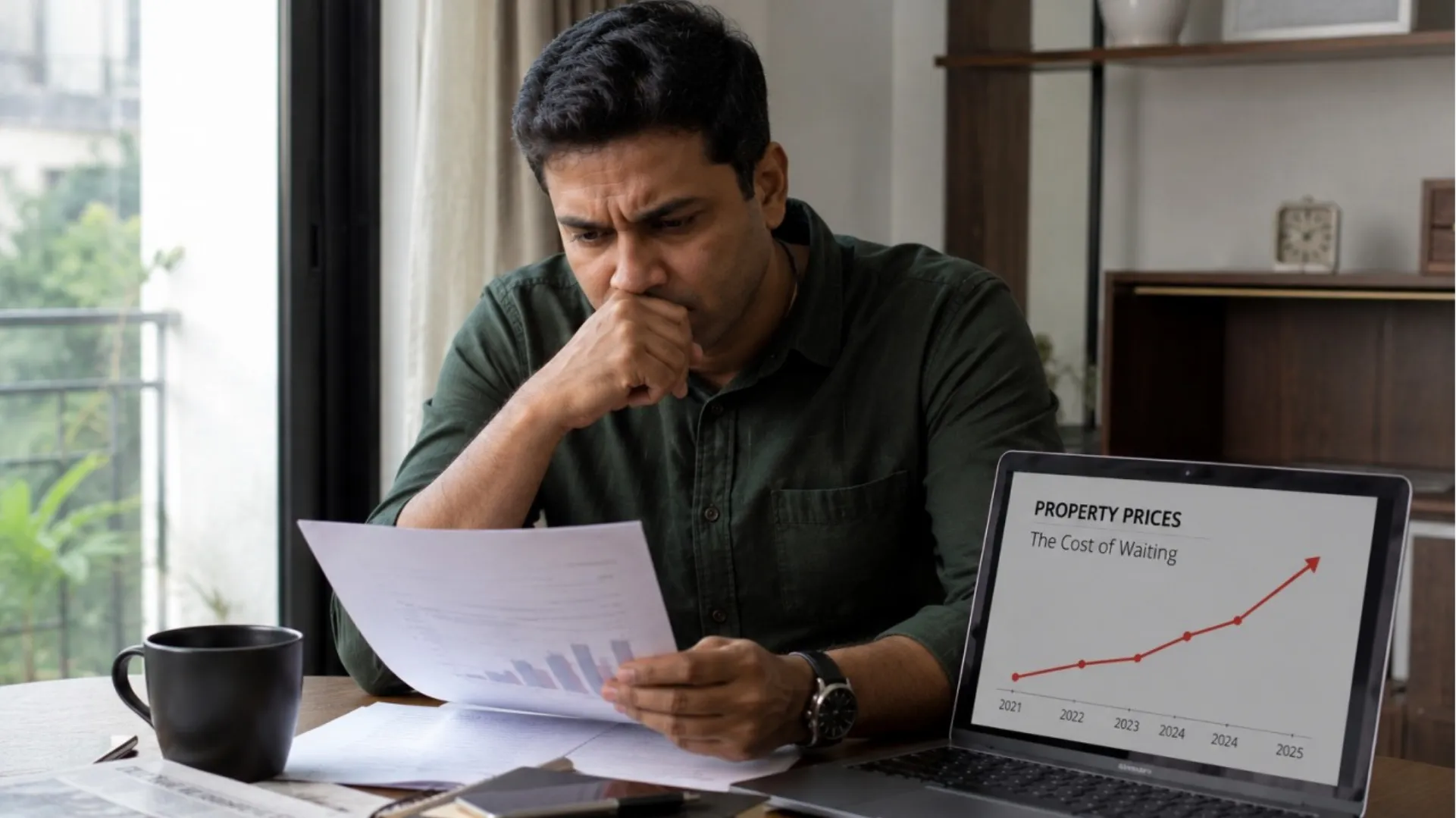
Take a ₹80 lakh flat in a corridor growing at 10%. One year later it becomes ₹88 lakh. Even after negotiating 3% off, you still pay ₹85.36 lakh—₹5.36 lakh more than buying earlier. Add another year of rent, a shorter loan tenure because you are older, and whatever interest rates did while you waited.
Banks lend against your remaining working years. A 32-year-old may qualify for a 25-year loan. A 42-year-old often gets only 18 years or less. The same loan therefore carries a higher EMI—not because interest rates changed, but simply because you became older while waiting. That cost can never be negotiated back.
Buy early, then negotiate hard—in that order. Winning a ₹2.5 lakh discount is valuable. But if six months of hesitation pushed the base price up by ₹6 lakh, you won the battle and lost the war. In growing corridors, timing usually matters more than bargaining.
Visit it. Do not rely on brochures. Check whether roads are actually being widened, metro pillars are standing, offices are leased or occupied, nearby projects are full, and new shops are opening. A rendering is a wish. A crane is a fact.
Treating “I don’t know” as a reason to wait. It is not. It is a reason to investigate. Buyers who complete their checks and walk away have made a decision. Buyers who never check anything and simply wait are postponing the work—and quietly paying for every month they postpone it.
No. Wait—but wait for yourself, not for the market. A financially stretched buyer is fragile. One unexpected expense can force a sale at the worst possible time. Build your emergency cushion first, then return to the market from a position of strength.
No. The point is not to buy today. The point is to stop waiting for a question that has no answer. Complete the nineteen-point checklist. If the property, builder, location, and your finances all check out, there is little reason to delay. If they do not, waiting becomes the correct decision—and you will know exactly why.
Let us end where we started.
“Let’s wait a little longer. Prices may come down.”
It is still one of the most reasonable sentences in real estate. It still sounds careful. And for many buyers, it becomes the most expensive sentence they ever say.
Waiting itself is not wrong. Sometimes it is exactly the right decision. We have already covered those situations. But there is a difference between waiting because the title is unclear and waiting because the market feels uncertain.
The first buyer has a reason and a finish line. The second has neither—and may still be waiting years later while watching an area they once called “too far” become “too expensive.”
The infrastructure does not pause while you research. The developer does not stop pouring concrete because you are undecided. The people moving into new offices are not waiting for your permission either.
Everything continues. Quietly. Physically. Quarter after quarter—whether or not you have made up your mind.
So do the work. Verify the title. Visit the builder’s completed projects. Stand beside the road and see whether it is actually being built. Run the numbers honestly. Then decide—one way or the other.
Because in property, the greatest cost is rarely paying today’s price. It is paying tomorrow’s price after doing yesterday’s research.
If this article has done its job, you are no longer asking whether prices will fall. You are asking whether anything meaningful is being built where you want to buy—and whether you are financially ready.
Those are questions with answers. Here is how to find them.
Take the nineteen-point checklist from Part 12 and apply it to one specific project this weekend—not three. One.
If it clears every point, you have your answer. If it fails even one critical check, you have your answer too—and you have saved yourself the most expensive kind of waiting.
Walk the corridor. Look at the construction. Ask for the RERA number and approved layout before anyone shows you a brochure. Speak to a resident—not a sales representative.
You will either buy with conviction or walk away with clarity. Both outcomes are infinitely more valuable than waiting another year for a headline that arrives too late to help you.