
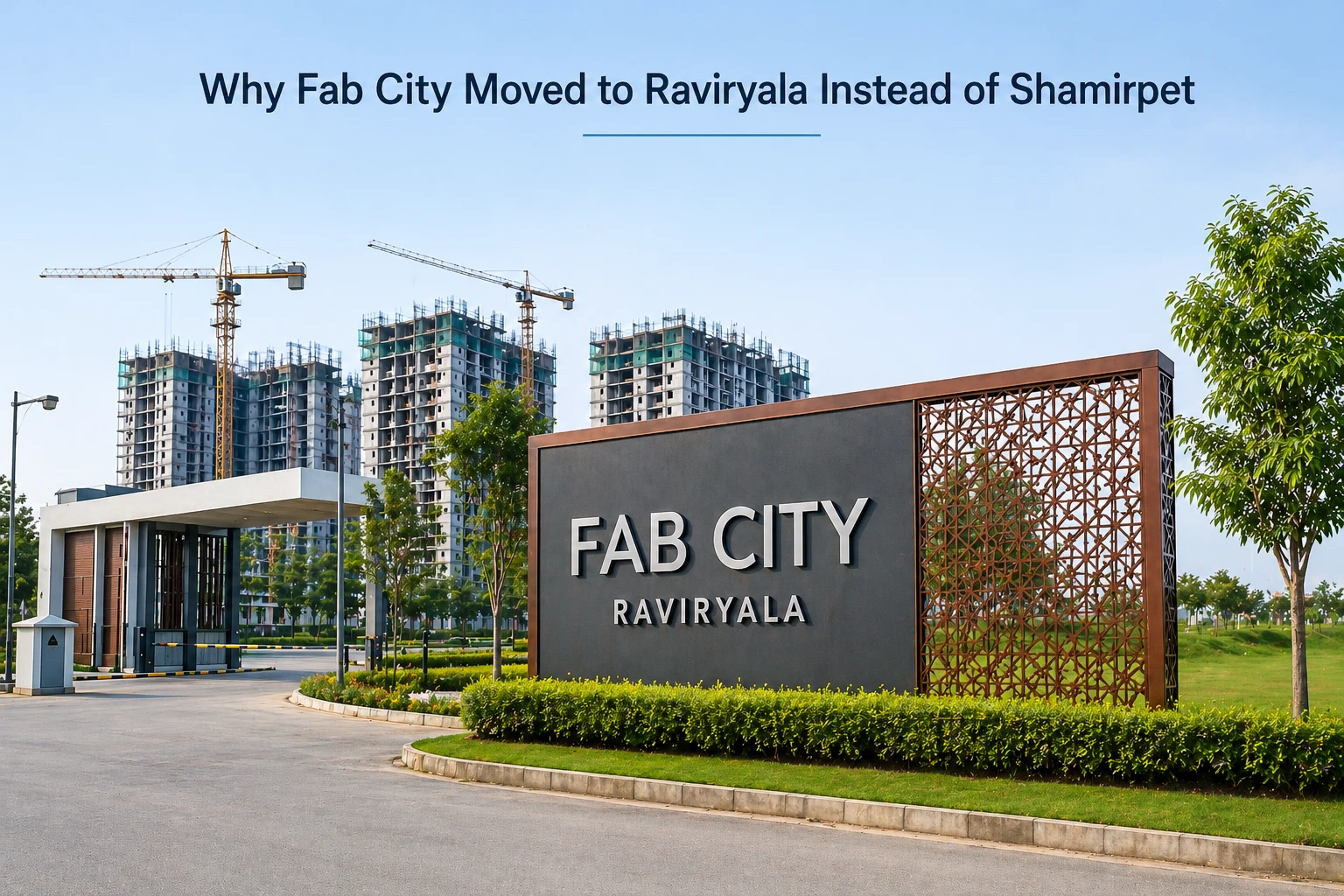
Why Fab City Moved to Raviryala Instead of Shamirpet: A Strategic Decision That Shaped Hyderabad’s Growth
infrastructure choices in Hyderabad’s modern development story. At first glance, both locations seemed viable. However, when examined through the lens of global manufacturing requirements, logistics, and long-term urban planning, Raviryala clearly emerged as the superior choice.
This move didn’t just influence industrial placement, it reshaped Hyderabad’s real estate growth, infrastructure expansion, and economic geography.
The Core Reason: The “Two-Hour Rule”
At the heart of the decision was a non-negotiable requirement from semiconductor companies:
products must reach an international airport within two hours of dispatch.
Raviryala delivered far beyond expectations.
- Distance to Airport: ~15 minutes from Shamshabad International Airport
- Shamirpet Limitation: Located in the northern corridor, significantly farther from the airport
- Impact: Faster exports, lower logistics cost, global competitiveness
For a semiconductor industry where time equals millions of dollars, this single factor outweighed almost everything else.
Strategic Location Advantage of Raviryala
Raviryala is positioned in the southern growth corridor of Hyderabad, which was already being developed with future infrastructure in mind.
Key Connectivity Benefits
- Direct access to Outer Ring Road (ORR)
- Close to Hyderabad–Srisailam Highway
- Seamless connectivity to Gachibowli and Financial District
- Proximity to Rajiv Gandhi International Airport
Shamirpet, although well-developed in terms of educational institutions and greenery, lacked this level of high-speed, export-oriented connectivity.
Infrastructure Readiness: A Deciding Edge
Semiconductor manufacturing is not just about land, it’s about ecosystem readiness.
Raviryala Offered:
- Assured water supply from Krishna River
- Reliable and subsidized power supply
- Large contiguous land parcels near key infrastructure
- Immediate access to transport corridors
Shamirpet Challenges:
- Less optimized for industrial logistics
- Not aligned with export-driven infrastructure
- Limited proximity to airport-based supply chains
This made Raviryala far more attractive for a high-tech manufacturing hub.
Government Strategy and Land Optimization
Initially, companies demanded around 5,000 acres of land. However, the government took a smarter approach:
- Selected ~1,200 acres near the airport instead of larger but distant land
- Prioritized efficiency over size
- Focused on long-term scalability and connectivity
This decision reflects a shift from traditional land allocation thinking to strategic urban planning.
Political Will and Competitive Pressure
The Fab City project was highly competitive, with multiple Indian states vying for it.
- States like Tamil Nadu, Karnataka, and Maharashtra aggressively lobbied
- Central-level political pressure also influenced decision-making
- Strong intervention by state leadership ensured Hyderabad retained the project
Ultimately, Raviryala’s logistical superiority gave policymakers a strong foundation to defend their choice.
What Happened Next: From Fab City to E-City
While the original semiconductor vision faced execution challenges, the location itself proved invaluable.
Evolution of the Region
- Transition from Fab City → E-City (Electronics Hub)
- Entry of global electronics manufacturers
- Integration with Future City developments
- Expansion of metro and road infrastructure
Today, Raviryala is no longer just a failed semiconductor dream, it is a multi-sector growth corridor.
Impact on Real Estate Growth
The decision to choose Raviryala over Shamirpet had a ripple effect on Hyderabad’s real estate market.
Key Outcomes
- Surge in land demand near ORR southern corridor
- Growth in residential and commercial projects
- Increased investor interest in Maheshwaram & surrounding areas
- Infrastructure-led appreciation in property values
Shamirpet, while still valuable, evolved more as an education and residential zone, whereas Raviryala became an industrial and economic driver.
Raviryala vs Shamirpet: Quick Comparison
| Factor | Raviryala | Shamirpet |
|---|---|---|
| Airport Proximity | ~15 minutes | Much farther |
| Logistics Efficiency | Excellent | Moderate |
| ORR Connectivity | Direct | Indirect |
| Industrial Suitability | High | Medium |
| Export Advantage | Strong | Limited |
| Real Estate Impact | High growth corridor | Stable residential growth |
Conclusion
The shift of Fab City to Raviryala instead of Shamirpet was not accidental, it was a calculated, future-focused decision rooted in logistics, infrastructure, and global competitiveness.
Raviryala met the critical demands of a semiconductor ecosystem: speed, connectivity, and resource availability. Even though the original Fab City vision didn’t fully materialize, the location itself proved to be a long-term asset, evolving into a thriving hub for electronics, IT, and future infrastructure.
In hindsight, this decision didn’t just choose a location. It defined Hyderabad’s southern growth story for decades to come.